Back
Seychelles Offshore Company Benefits (and the Drawbacks)
The real benefits of a Seychelles offshore company: 0% tax on foreign income, about US$850 a year to run, 1-3 day setup, and the drawbacks to weigh first.

Licensed auditor & chartered accountant · 6 years of experience in offshore accounting

A Seychelles offshore company pays no tax on income earned abroad, costs well under a thousand dollars a year to keep alive, and can be registered in days without leaving your desk. Those benefits are real, and so are the trade-offs that come with them. In this post, we’ll walk you through both halves: what a Seychelles IBC actually gives you, what it doesn’t, and who should and shouldn’t register one.
Quick Summary
Tax is territorial: 0% on foreign-sourced income, no capital gains tax, no withholding tax on dividends from foreign income; only Seychelles-sourced income is taxed, at 15% then 25%.
Running costs are low: US$130 to register, US$140 per year in government fees, and around US$850 per year all-in with a provider handling everything.
One person can be the sole director and sole shareholder, from any country, with no minimum capital and no audit for a standard IBC.
Shareholders are not on any public register; director names become publicly available from 1 January 2027; beneficial owners sit in a non-public government database.
Setup takes 1-3 business days after KYC approval and the entire process is remote.
The main drawbacks: banking is the hard part, your home country still taxes you under its own rules, IBCs get no double tax treaty access, and accounting records are due twice a year.
Tax Benefits of a Seychelles Company
The headline benefit is the tax system, and it holds up under inspection. Seychelles taxes on a territorial basis: only Seychelles-sourced income is taxed, per the Seychelles Revenue Commission. An IBC whose customers, contracts and operations all sit outside Seychelles pays no Seychelles business tax on that income, no capital gains tax, and no withholding tax on dividends paid out of foreign income. Local income, if any, is taxed at 15% on the first SCR 1 million and 25% above it.
There is one substance caveat. Since the Business Tax (Amendment) Act 2020, companies in multinational groups keep the exemption on foreign passive income (dividends, interest, royalties, rents) only with adequate substance in Seychelles, with a lighter test for pure equity holding companies. A standalone trading company selling services abroad is not caught by this; a group vehicle collecting royalties might be.
And one caveat that applies to everyone: your home country’s controlled foreign company and place-of-effective-management rules apply regardless of anything in Seychelles law. If you live in a residence-taxing country, get local advice before building a plan on a 0% rate.
On reputation, the picture improved in 2026: the Council of the EU removed Seychelles from its Annex II watchlist on 17 February 2026, so it now appears on neither EU list, and it is not on the FATF increased monitoring list either.
Cost and Simplicity
Few jurisdictions are cheaper to enter or to stay in. Under the FSA’s published fee schedule, registration costs US$130 and the annual government fee is US$140. Our all-in package, covering government fees, the registered office, registers, filings and the document pack, runs US$850 for year one and US$850 per renewal, so the realistic Seychelles company cost is under a thousand dollars a year unless you add nominees or licensing.
The structure is as light as the fees. One director and one shareholder are enough, and they can be the same person, of any nationality, living anywhere; a non-resident can own 100% of a Seychelles company with no local partner. There is no minimum share capital, no company secretary, no annual general meeting, and no audit requirement for a standard IBC. A single founder can hold the whole company in one pair of hands and keep the annual paperwork to a handful of filings.
Privacy: What You Actually Get
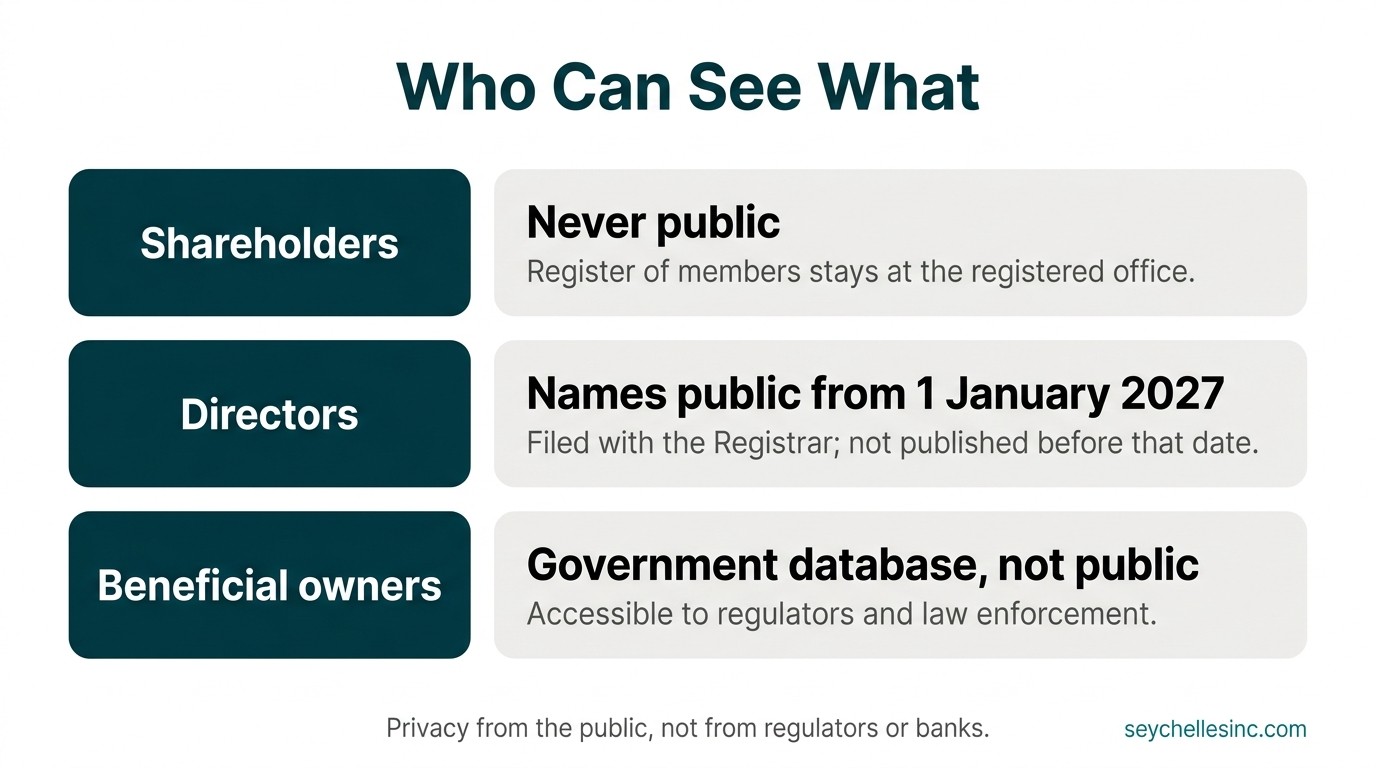
Seychelles offers more privacy than most jurisdictions, but the useful way to think about it is privacy from the public, not from regulators or banks.
What stays private: the register of members is kept at the registered office, is not filed with the Registrar, and is not public. Nobody can look up who owns your company through a public search, and that does not change in 2027.
What changes: director names are filed with the Registrar and are currently not published, but under the International Business Companies (Amendment) Act 2026 the names and appointment dates of current directors become publicly inspectable from 1 January 2027. A sole director-shareholder will be findable by name from that date, even though the shareholding stays off the record.
What was never private from authorities: beneficial owners, meaning anyone with 10% or more ownership or control, are filed to a non-public database run by the Financial Intelligence Unit, which the listed authorities can access and which is shared with foreign tax authorities on request. Banks ask for full disclosure during onboarding anyway. Anyone promising invisibility from regulators is promising something that does not exist.
Speed and Remote Setup

Speed is the benefit people underrate until they’ve incorporated somewhere slow. A Seychelles IBC is typically registered within 1-3 business days after KYC approval, and the entire Seychelles company formation process is remote: documents are certified where you live, the licensed provider files everything, and your document pack arrives digitally. No travel, no local notary, no in-person appointments.
The paperwork also travels well. Seychelles has been party to the Hague Apostille Convention since 1979, so documents are apostilled rather than embassy-legalised, which is the form banks and counterparties abroad usually ask for.
The Drawbacks Nobody Puts in the Brochure
These are the points that come up after formation rather than before it. Read them before you pay anyone.
Banking is the hard part. A certificate of incorporation is not a bank account. Seychelles local banks take 4-8 weeks with a full file, regional banks want substance and balances, and most small online businesses end up with electronic money institutions: faster to open, pricier per transaction, and selective about industries, with acceptance policies that change every year. We handle Seychelles bank account applications as a separate engagement, and approval is always the institution’s decision.
Your home-country tax bill does not disappear. If you manage the company from your kitchen table in a country with CFC or effective-management rules, that country will usually tax the profits as if the company were local. The IBC changes where the company is registered, not where you live.
No double tax treaty access. An IBC cannot use Seychelles’ tax treaties, so withholding taxes on dividends, interest or royalties flowing from treaty countries are not reduced. Seychelles offers a different vehicle, the CSL, for treaty-dependent structures, but it is a heavier and costlier setup.
Some counterparties apply extra scrutiny. Certain banks, payment processors and larger customers put offshore jurisdictions through additional due diligence. That usually means more questions and slower onboarding, not refusal, but budget the time for it.
Accounting records are a real obligation. Records sufficient to explain the company’s transactions must be kept at the registered office, with bi-annual lodging deadlines under FSA Circular No. 9 of 2021: January-June records by 31 July, July-December by 31 January. Penalties run up to US$10,000. There is no audit, but “no filings at all” stopped being true in 2021.
Director privacy ends in 2027. If keeping your name off public record as a director was part of the appeal, the 2026 Amendment Act removes that from 1 January 2027. Shareholders stay private; directors do not.
Is a Seychelles Company Worth It?
For the right business, yes, and the fit is easy to test. A Seychelles IBC is worth it if:
You run an international service business. Consultants, agencies, SaaS and ecommerce operators selling outside Seychelles get the full territorial tax benefit with minimal admin.
You trade across borders and want one neutral entity for invoicing, contracts and supplier relationships in several countries.
You need a holding vehicle for foreign shares, property or intellectual property, kept legally separate from your personal name.
You are cost-sensitive. At roughly US$850 a year all-in, Seychelles undercuts most comparable jurisdictions on both entry and renewal.
You are building a licensed fintech, forex or crypto operation and are prepared to go through FSA licensing, with the IBC or a related vehicle as the corporate base.
It’s probably not worth it if:
You live in a strict-CFC country and will manage everything from home. The home tax bill stays, and you’ll have paid for a second layer of compliance on top of it.
Your model depends on tax treaties. An IBC has no treaty access; if that’s the core of the plan, look at a CSL or a treaty jurisdiction instead.
Your business is in Seychelles. Local income is taxed locally and licensing applies, which removes most of the advantage.
If the fit column describes you, we register Seychelles IBCs for US$850 all-in, covering government fees, the registered office, all filings and the document pack, with renewals at the same price.
FAQ
What are the disadvantages of a Seychelles company?
Banking friction (accounts take 1-8 weeks and many businesses end up with electronic money institutions), no double tax treaty access, extra due diligence from some counterparties, twice-yearly accounting record deadlines with fines up to US$10,000, and home-country tax that applies under its own rules regardless.
Does a Seychelles offshore company pay any tax?
Not on foreign-sourced income. The system is territorial, so only Seychelles-sourced income is taxed, at 15% on the first SCR 1 million and 25% above. There is no capital gains tax and no withholding tax on dividends paid from foreign income.
Is a Seychelles company anonymous?
No. Shareholders are not on a public register, but beneficial owners are filed to a government database that authorities can access and share with foreign tax authorities on request, and director names become public from 1 January 2027. The privacy is from casual public searches, not from regulators or banks.
Who should register a Seychelles company?
Founders selling services or goods internationally, cross-border traders, owners of foreign assets who need a holding vehicle, and fintech operators pursuing an FSA licence. It suits people who want low costs and light admin, not treaty planning.
How much does a Seychelles company cost per year?
The government charges US$140 per year, and a full renewal package covering the registered office, filings and compliance runs about US$850 per year with us. Add-ons like nominees or accounting support are priced separately.